Game Preview: St. John’s @ Seton Hall (-4.5) – 12/11

The Big East is back on a Friday night, as the Johnnies travel to the Rock in Newark, NJ to take on rivals Seton Hall. Both teams had the chance to tune-up for this fight as each won against low-major competition on Tuesday. Seton Hall has been tested early, opening the season 1-3 with three losses to KenPom Top 100 teams. They’ve rebounded with an overtime win on the road at Penn State last week and now sit at 3-3 on the year. St. John’s has started well out of the gate notching five wins including one over Boston College and just one loss coming to BYU. They’ll face their toughest challenge of the young season on Friday night.

We have a tempo battle on our hands here. St. John’s plays a blistering pace, the 9th fastest in the country fueled by an aggressive defense that generates a live-ball steal on 16% of its opponents’ possessions (also 9th best in the country). On the other side, Seton Hall is more strategic on offense and will make you work for a shot on defense. They play at the 266th fastest pace in D-I hoops. St. John’s will try to speed it up, and Seton Hall will try to slow it down, whoever can get the game at the pace they like will have an advantage.

Seton Hall is led by senior big man Sandro Mamukelashvili and junior guard Jared Rhoden who have accounted for 44% of the team’s points this season. The focal point of the Pirate’s strategy to drive hard to the rim and get fouled or kick to an open shooter. Seton Hall is top-20 in the country in getting to the free-throw line. Rhoden has led that charge with the most free-throw attempts on the team. Mamukelashvili can find space to receive a pass for a dunk on these drives or float to the three-point line where he shot an astounding 43.4% last season. The question marks surround the point guard position. Talented Harvard-transfer Bryce Aiken has been sidelined with an ankle injury. His replacement Shavar Reynolds has played well, averaging 9.5 pts/5.7 ast/2.2 stl in Aiken’s absence. However, Reynolds has turned the ball over 2.2 times per game. His ball security will be a pivotal factor against the tenacious St. John’s guards.

St. John’s is led by sophomore utility man Julian Champagnie. At 6’7″, he is listed as a guard, but you will find him floating down low and causing havoc on the offensive glass (2.5 ORB per game). He is supported by a stable of guards (Posh Alexander, Vince Cole, Greg Williams) and other positionless athletes Marcus Earlington and Isaih Moore. This group also wants to get to the rim, especially in transition. They rank 270th in three-point attempts and attempt 50% of their field goals at the rim (Hoop-Math). The Johnnies also face their own issues at point guard, as returning senior Rasheem Dunn has missed time with a concussion. His steady hand and shot-creating would be a boost to get back in the lineup for Big East play. Freshman Posh Alexander has shown flashes of talent filling in at the point, but he has committed 3.5 turnovers per game. In contested a game that likely will be close late, point guard play will be at a premium.

Neither team sports a particularly dynamic defense and I think St. John’s will be able to get out in transition and speed this game up. However, the Red Storms’s lackluster 2PT defense (245th) could allow Sandro to have a big game. The quick pace combined with both team’s penchant for going inside could also result in fouls piling up on both sides. This could be a battle of depth for large stretches. I think we will see lots of points in close game. If Dunn plays I will give the edge to St. John’s, if not I think Seton Hall pulls it out.

Game Preview: Indiana @ Florida St. (-3) – 12/9

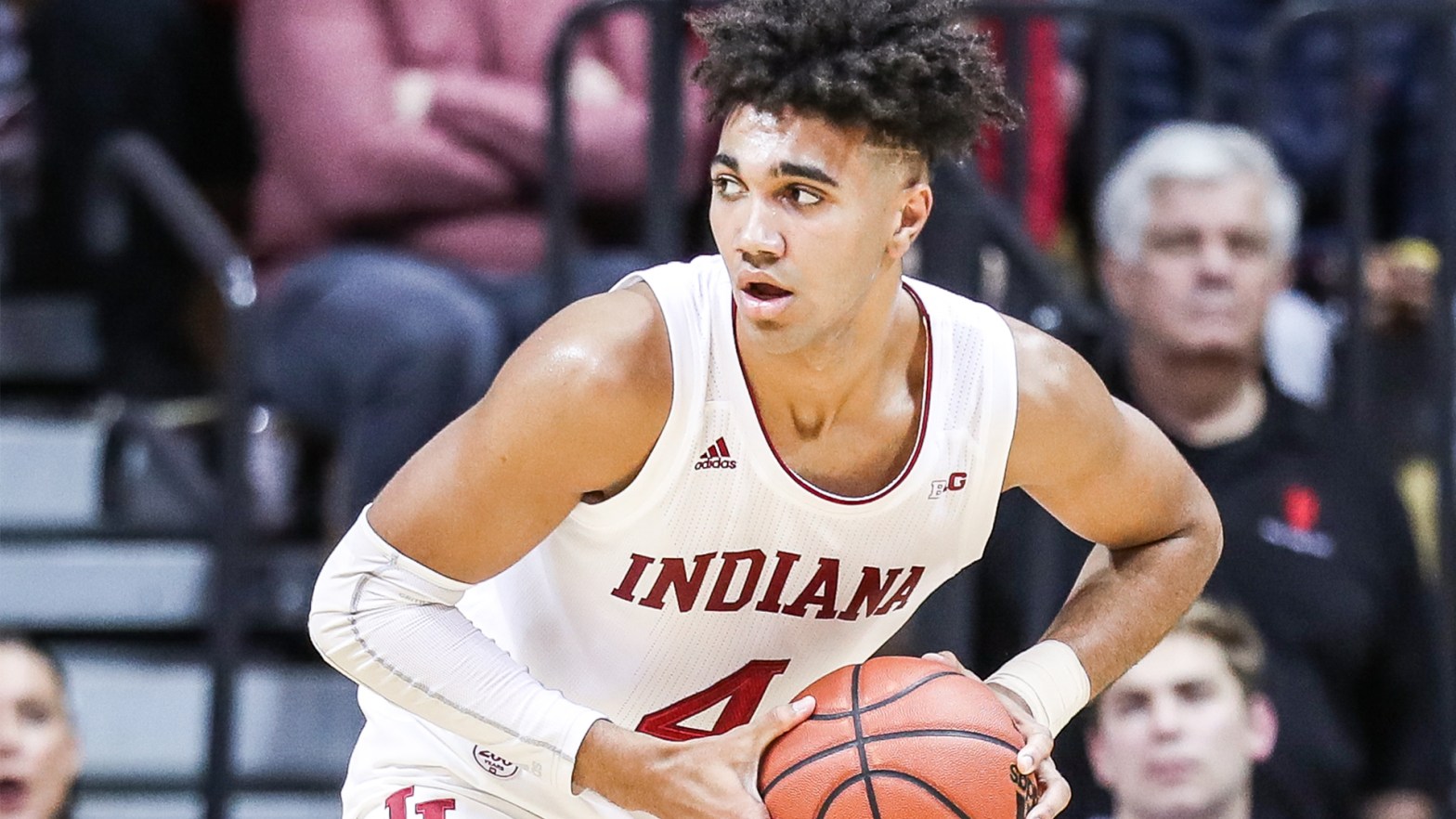
Indiana heads on the road to Florida St. in one of the better matchups of the ACC-B1G challenge. Indiana has been tested early with wins over KenPom Top-100 teams Stanford and Providence while falling to KenPom’s #5 Texas Longhorns. The Hoosiers are led by the tremendous 2nd Team Preseason All-American Trayce Jackson-Davis who is averaging 21.5 points, 7.5 rebounds, and 1.5 assists so far this season.

Florida St. opened the season with a blowout win over cupcake North Florida a week ago and have not played since. The ‘Noles lost some major pieces from last year in NBA lottery picks Devin Vassell and Patrick Williams, as well as their former second-leading scorer Trent Forrest. However, Leonard Hamilton returns almost every other contributor and adds 5-star freshman Scottie Barnes. Senior guard M.J. Walker emerged as the team’s first choice offensively in their season opener, pouring in 17 points in 27 minutes on just eight field-goal attempts.

This is an interesting matchup early in the season because these two teams want to play a pretty similar style of basketball. They both sport very good defenses (both top 16 in Adj. Def at KenPom) and offenses not focused on the three-point shot. Both teams have consistently ranked near 200th in 3PA% over the last four years. Both teams also feature athletic guards that put pressure on ball-handlers. Indiana’s guards hounded Providence and used their athleticism to disrupt the Friars’ offensive flow along the perimeter. This will be tougher for Indiana to pull off against Florida St. that always has one of the most athletic teams in the country.

Despite both being effective defense, they each emphasize a different phase of the game. Indiana has locked down on outside point shooters, allowing opponents to shoot just 23% from three. This comes at the expense of their 2P defense, as Indiana has allowed a mediocre 48% on FG from inside the arc. On the other side, Florida St. focuses on toughening up inside. They have been among the 50 best defenses against 2P shots three of the last four years (coming in at 70th last season) and allowed just eight 2-pointers in their first outing of the season. This defense comes from strong guards that prevent penetration, length through the team, and is bolstered by 7-foot center Balsa Koprivica.

The key to the game lies in the matchup between the dominant interior scorer Trayce Jackson-Davis and the stiff Florida St. interior defense. If Florida St. decides to focus on TJD, can Jackson-Davis find open teammates and will they be able to knock down shots? This will likely be a grinding game where each possession matters. Both teams will need to get easy buckets in transition when they can. I don’t think Indiana has enough secondary scoring to get it done, and Florida St. rides its defense to a win in a slugfest.

How Indiana Wins: An efficient game from TJD and their defense cements that it’s for real.

How Florida St. Wins: Make Indiana uncomfortable on offense and get in the lane consistently.

Question Marks:

  1. Where does the offense come from for Florida St.?
  2. Can 7-footer Koprivica stay with Jackson-Davis?
  3. Who wins the guard battle?
  4. Can Indiana generate secondary looks if TJD is getting taken out of the game?

Game Recap: Wofford @ Richmond – Monday 12/7

Final Score: Richmond 77, Wofford 72 (Richmond -12.5)

Wofford travelled to Richmond in a game that was added to the schedule just two days before tip-off due to COVID reshuffling. Richmond came into the game ranked #19 in the AP poll after easily defeating Kentucky – the Spiders’ first appearance in the top 25 since the 2009-10 season. Wofford lost their top two scorers from a year ago, but return the rest of their top-5 bucket getters. The Terriers entered the game 2-0 but untested, with easy wins over two non-D1 programs. I love these kinds of games. Two smaller schools, both well-coached, with talented players that the college basketball world will get to know throughout the season. A Monday afternoon game is also a great way to start the week.

Richmond came in as a 12.5 point favorite, but that clearly proved to be way too many points. Wofford looked efficient on offense with multiple guys who can hit tough shots. Senior guards Storm Murphy and Tray Hallowell consistently hit three pointers over the shorter Spider guards, they finished with 21 and 15 points respectively at a combined 43% shooting clip. Messiah Jones also put in a strong performance with 20 points on 9-11 shooting, including 1-2 from three and adding 3 offensive rebounds.

Offensive rebounding was one weakness of Richmond’s that Wofford exposed, winning that battle 12-6. Burton and Cayo, the two 6’7″ forwards did combine for 12 defensive rebounds, but center Grant Golden needs more help cleaning limiting second chance opportunities. The 6’10” senior grabbed just one defensive rebound.

The Richmond offense was at its best in transition. The senior guards Gilyard and Francis can turn defense to offense, finishing off steals, blocks, and rebounds at the other end. The much-praised defense of Richmond left something to be desired in their half-court rotations and shot contesting. They were overaggressive at times tending to reach-in, overplay off-ball, and go for too many steals. They do generate turnovers, as Wofford turned it over on 20% of their possessions, but the half-court team defense could use improvement.

The most impressive part of Richmond is how many shot creators they have on an A-10 team. They have four guys that can really take you off the bounce in Gilyard, Francis, Cayo, and 6th man Gustavson. They also have two bigger guys with touch at three levels in Golden and Burton. Junior guard Gustavson was a surprise contributor who caught my attention. He’s a bigger guard than Richmond’s starting pair at 6’4″ and impressed getting into the lane where he was 4-4 on 2PTs. The offense seemed to spin the ball well when he was initiating.

Takeaways

Richmond is a dangerous team with a turnover generating defense, many shot makers, and dynamic senior guards. Their questions will come against teams that can hammer them in the post and on the offensive glass, teams with efficient half-court offenses, or with bigger experienced guards that take care of the ball (The last two points likely being why Wofford was able to keep this close).

Wofford will have a solid season with their own pair of senior guards, Messiah Jones, and a solid offensive system. Their question lays in their depth, with only six players logging more than 10 minutes, and only seven players seeing any time at all. The big 3 of Murphy, Hallowell, and Jones combined for 56/72 points. The Terriers will need more scoring and more minutes from the bench to make it through the season.

Why Odell meant almost nothing to Giants’ “brand”

*All NFL game data courtesy of https://www.pro-football-reference.com/. All TV ratings data courtesy of https://www.sportsmediawatch.com/.

Odell Beckham Jr. made headlines this week on the tails of his interview with GQ. The most controversial piece came when OBJ was asked about how he felt when the Giants traded him away.

“I felt disrespected, because I felt like I was a main reason at keeping that brand alive. They were getting prime-time games, still, as a 5-and-11 team. Why? Because people want to see the show. You want to see me play. That’s just real rap. I’m not sitting here like, “It’s because of me.” But let’s just be real. That’s why we’re still getting prime-time games.”

Odell is undoubtedly a talented player. However, claiming to be the main reason for “keeping the Giants brand alive” is a ludicrous statement. The Giants are a historic franchise in the largest media market of the most valuable league in sports. Even so, let’s humor the notion for a minute.

Following Odell’s argument, the Giants “brand” would surely take a hit after shipping their main attraction to Cleveland. If the Big Mac went over to play for Burger King, it probably wouldn’t be great for McDonald’s stock price. The value of the Giants should then similarly take a dive. With a fantastic sense of irony, Forbes dropped their list of the 50 most valuable sports franchises this very same week. The Giants’ valuation remained constant from 2018 at $3.3 billion, good enough to remain in the top-10 most valuable franchises across sports and good enough to remain as the #3 most valuable NFL franchise. Sorry Odell, the brand looks good.

Okay, but valuation takes into account so many different factors, there’s no way that losing a player even as talented as Beckham would impact the overall value of the franchise. Sure, fine. Then, let’s look at the primetime games that OBJ referenced.

Since 2016, the Giants have played 26 games in primetime (not on NFL Network), tied for fourth most in that timespan. Across primetime games, the Giants have averaged a TV rating of 9.83 (9th highest in the NFL). The top-10 figures indicate that the Giants have a baseline of high popularity. Is it due to Beckham?

For primetime games in which Beckham played the last three seasons, the average rating ticked up to 10.3 (7th), versus a 9.3 rating (16th) without him. So OBJ takes the Giants from average ratings to elite ratings? “Not so fast, my friends” said Lee Corso on a brisk fall Saturday morning.

Half of Beckham’s games played over the last three years came in 2016. That same year the Giants posted an 11-5 record and made the playoffs.  During this season, Giants’ primetime games averaged an astounding 11.1 rating. This would be good for the second highest in the NFL over the last three years. Likely the success of the team and the added drama of a playoff push accounted for these high ratings. The high ratings for the playoff season drag the average ratings for Odell games higher, making him seem more valuable than he really is to the “brand”.

Well, you may be thinking, Odell playing more often causes the Giants to win more often and winning more often causes better ratings, so Odell causes better ratings. Well, not really. The Giants were 15-17 with Odell over the last three years. Not exactly a record indicating that Odell causes much winning at all.

After the playoff season, in 2017 and 2018, the Giants were 4-12 with Odell and 4-12 without Odell. The Giants actually posted better ratings in games that Odell did not play (8.5 with, 9.3 without). However, they did play two more games against the ratings-juggernaut Cowboys in the absence of OBJ. Removing the two highest rated NYG-DAL games without OBJ, the ratings with and without Odell are basically the same (8.5 with, 8.3 without). There seems to be no impact of OBJ on viewership of primetime games that does not depend on the Giants actually being a good football team. Therefore, the team is what matters more to the brand than Odell.  

So the Giants win at the same rate with and without Odell, draw viewers at the same rate with and without Odell, and have the same financial valuation with and without Odell. All evidence points to the fact that having Odell Beckham on your team really doesn’t matter.  It is probably better to get rid of a guy that doesn’t help than to pay him close to $100 million. So, OBJ, next time you feel disrespected by the Giants, don’t. That’s just real rap.

The case for pace: Refuting the narrative that Virginia’s style can’t succeed in March

All statistics are courtesy of https://www.sports-reference.com/cbb unless otherwise stated.

March 27, 2019

Virginia is slow. Virginia is boring. Virginia can’t win in March with the style they play. Virginia will never make a Final Four. All are common refrains among college basketball analysts and fans alike and have been for years.

The reason Virginia tends to be a popular upset pick is that people believe teams with slower pace of play are more likely to lose to underdogs. The popular conception is that slow pace limits the number of possessions in the game, which lends added weight to each quasi-random bounce of the ball, minimizing opportunities for the true talent differential to shine through. The crazy 35-foot fadeaway three-pointer has a larger impact on the result of the game when there are fewer opportunities to offset that lucky play. Additionally, playing so slowly makes it tougher for Virginia to come back from deficits when they find themselves down.

Virginia’s first-of-its-kind loss last year to UMBC was the last piece of evidence the public needed to prove once and for all that the above narratives are true. Coach Tony Bennett’s gimmicky style is a guaranteed loser in March.

It turns out, these narratives are at worst wrong and at best lazy.

We looked at every game involving a 1-seed or 2-seed matched up against a lower seed from each NCAA Tournament since 2010 to see if pace made a team more or less likely to be upset by a lower seed.

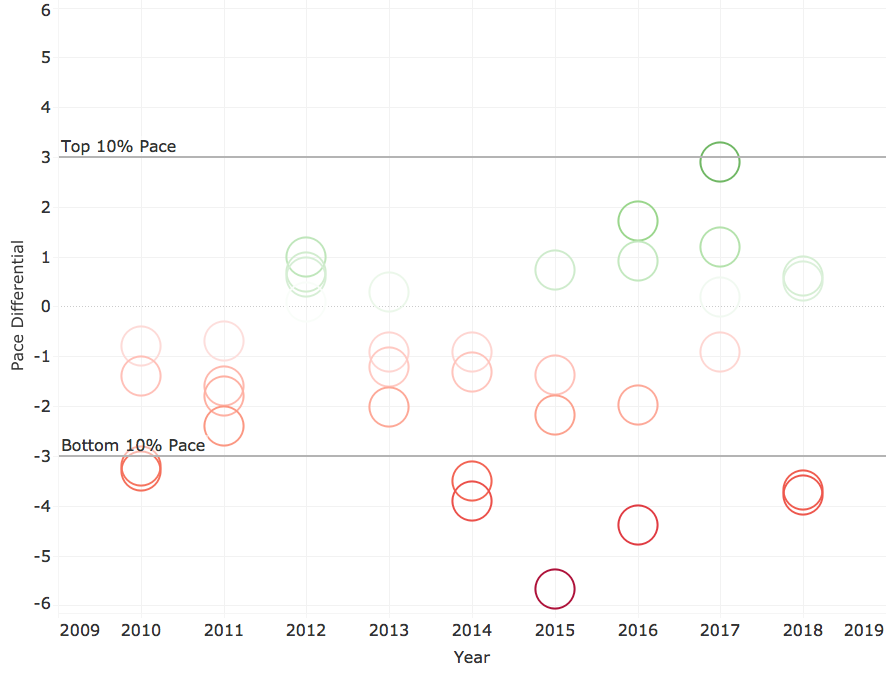
Pace can be quantified by the average number of possessions a team will have in a 40-minute game. We subtracted each team’s pace from the average pace of the league that year to provide a relative metric, pace differential. A negative pace differential means the team plays more slowly than average. A positive pace differential means the team plays more quickly than average.

How slowly does Virginia play?*

*As a 1-seed or 2-seed in the NCAA Tournament

Among games played by one and two seeds against lower seeds, the favorites beat 78 percent of opponents regardless of pace. Teams with negative and positive pace differentials posted similar winning percentages. Teams with a negative pace differential won 75 percent of their games, while teams with positive pace differential posted an 81 percent win rate. If a team is elite (a top two seed), it will be just as likely to beat an inferior opponent playing slowly or quickly.

However, Virginia isn’t just a below average team in pace. UVa consistently ranks among the slowest teams in the country. Looking at the last nine seasons, The slowest 10 percent of teams generally average at least three fewer possessions per game than the average team. Are these the teams that analysts suggest are upset in a significant proportion of NCAA Tournament games? These slow teams have still won 67 percent of their potential upset games. The slowest teams (which we define as having a pace differential <-4) like the Cavaliers, have won 75 percent of potential upset games, nearly matching the 78 percent clip of the larger sample.

However, the public may well remain unconvinced. Even if Virginia and its fellow slower brethren are not more likely to be upset by lower seeds, can they achieve the mark of a great team, reaching the Final Four? Of the 36 teams that made the Final Four since 2010, six played at a pace in the bottom ten percent and only  one played at a top ten percent pace. The trend holds more broadly as well. Of the last 36 Final Four teams, 29 played at a below average pace and only seven teams played at an above average pace.

How fast do Final Four teams play?

A slow pace does not preclude a Final Four appearance — in fact, it may even improve a team’s chances. A slow pace does not lead to a significantly higher likelihood of upsets.

But if it’s not the pace of play, something has still been the problem. Almost every March has come with a high profile upset of Tony Bennett’s Cavaliers — UMBC in 2018, Syracuse in 2016 and Michigan State in 2015. The Cavaliers have been one of the only top teams in Division 1 to vastly underperform in the Tournament since 2010. Their success in the regular season makes their failures in the postseason more salient. Sure they can win tough games in January, but maybe there’s something inherently unique about winning in Tournament play?

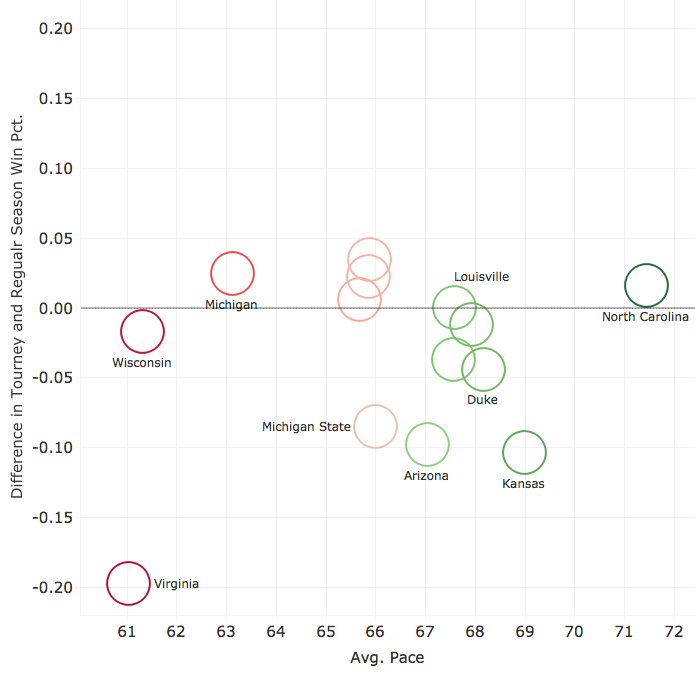
This not true for most other elite programs. The other top teams since 2010 have nearly identical winning percentages in the regular season and March Madness. However, Virginia’s Tournament winning percentage is 20 points lower than its regular season percentage. No other elite team has a difference near that magnitude. 

Do teams play differently in the Tournament?

Virginia has been abnormally bad in the postseason compared to other top programs, even those that play just as slowly. Is there truly something different about Virginia’s play that causes this? I would argue it is not in Virginia’s style but in a lack of games played. Virginia has played seven fewer Tournament games than the next lowest team, Arizona.

The winning percentage in the Tournament for slow teams is no different from the average rate, slow teams make the Final Four more often than faster teams, and top teams perform the same way in March as they do in the regular season. We should then expect that as Virginia plays more games in the Tournament, their March winning percentage will approach their regular season winning percentage.

The bias against Virginia is more emotional than basketball-related. When people watch the ‘Hoos, they do not see the style normally associated with elite programs. The four “blue bloods” — Kentucky, Kansas, Duke and North Carolina — are consistently the four fastest teams among top programs. That style is what is normally associated with the best college basketball teams. A fast pace is what college basketball fans and analysts are used to seeing win.

Not enjoying Virginia basketball is okay — well, no it’s not, it’s a thing of beauty — but saying the style makes them incapable of winning big games is lazy. Many analysts stop the argument there. They play slowly so they can’t win. Why? The style may be unfamiliar and unenjoyable to the casual fan, but it wins and it wins a lot.

While Virginia clearly has prior postseason failures, the entire body of work for the Cavaliers is impressive. Ultimately, the quality of the basketball will win out against the detractors of the style, and Tony Bennett will ultimately lead Virginia to the promised land. Whether this year is that year? We can only hope.