All statistics are courtesy of https://www.sports-reference.com/cbb unless otherwise stated.
March 27, 2019
Virginia is slow. Virginia is boring. Virginia can’t win in March with the style they play. Virginia will never make a Final Four. All are common refrains among college basketball analysts and fans alike and have been for years.
The reason Virginia tends to be a popular upset pick is that people believe teams with slower pace of play are more likely to lose to underdogs. The popular conception is that slow pace limits the number of possessions in the game, which lends added weight to each quasi-random bounce of the ball, minimizing opportunities for the true talent differential to shine through. The crazy 35-foot fadeaway three-pointer has a larger impact on the result of the game when there are fewer opportunities to offset that lucky play. Additionally, playing so slowly makes it tougher for Virginia to come back from deficits when they find themselves down.
Virginia’s first-of-its-kind loss last year to UMBC was the last piece of evidence the public needed to prove once and for all that the above narratives are true. Coach Tony Bennett’s gimmicky style is a guaranteed loser in March.
It turns out, these narratives are at worst wrong and at best lazy.
We looked at every game involving a 1-seed or 2-seed matched up against a lower seed from each NCAA Tournament since 2010 to see if pace made a team more or less likely to be upset by a lower seed.
Pace can be quantified by the average number of possessions a team will have in a 40-minute game. We subtracted each team’s pace from the average pace of the league that year to provide a relative metric, pace differential. A negative pace differential means the team plays more slowly than average. A positive pace differential means the team plays more quickly than average.
How slowly does Virginia play?*
*As a 1-seed or 2-seed in the NCAA Tournament

Among games played by one and two seeds against lower seeds, the favorites beat 78 percent of opponents regardless of pace. Teams with negative and positive pace differentials posted similar winning percentages. Teams with a negative pace differential won 75 percent of their games, while teams with positive pace differential posted an 81 percent win rate. If a team is elite (a top two seed), it will be just as likely to beat an inferior opponent playing slowly or quickly.
However, Virginia isn’t just a below average team in pace. UVa consistently ranks among the slowest teams in the country. Looking at the last nine seasons, The slowest 10 percent of teams generally average at least three fewer possessions per game than the average team. Are these the teams that analysts suggest are upset in a significant proportion of NCAA Tournament games? These slow teams have still won 67 percent of their potential upset games. The slowest teams (which we define as having a pace differential <-4) like the Cavaliers, have won 75 percent of potential upset games, nearly matching the 78 percent clip of the larger sample.
However, the public may well remain unconvinced. Even if Virginia and its fellow slower brethren are not more likely to be upset by lower seeds, can they achieve the mark of a great team, reaching the Final Four? Of the 36 teams that made the Final Four since 2010, six played at a pace in the bottom ten percent and only one played at a top ten percent pace. The trend holds more broadly as well. Of the last 36 Final Four teams, 29 played at a below average pace and only seven teams played at an above average pace.
How fast do Final Four teams play?
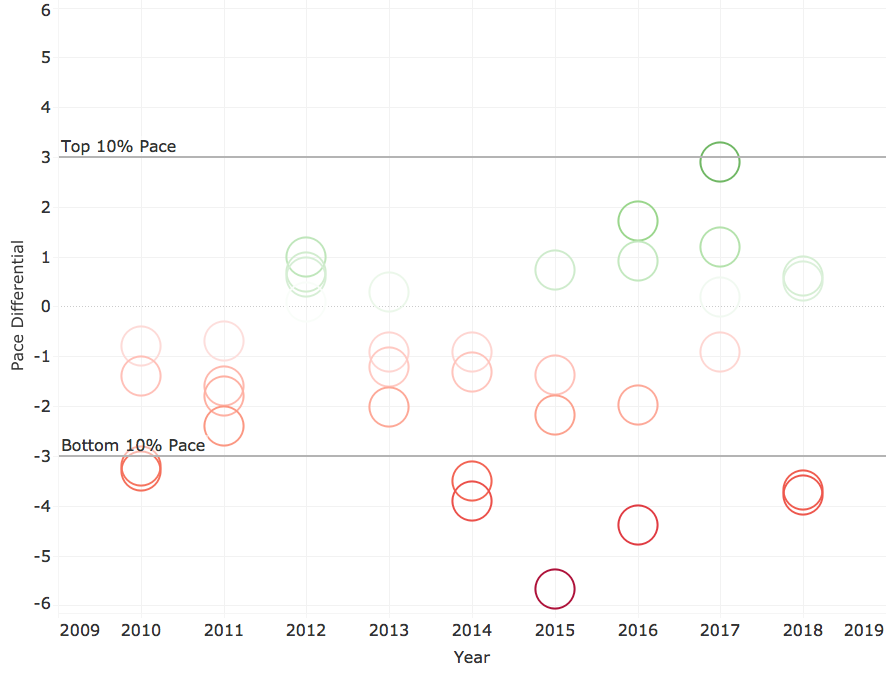
A slow pace does not preclude a Final Four appearance — in fact, it may even improve a team’s chances. A slow pace does not lead to a significantly higher likelihood of upsets.
But if it’s not the pace of play, something has still been the problem. Almost every March has come with a high profile upset of Tony Bennett’s Cavaliers — UMBC in 2018, Syracuse in 2016 and Michigan State in 2015. The Cavaliers have been one of the only top teams in Division 1 to vastly underperform in the Tournament since 2010. Their success in the regular season makes their failures in the postseason more salient. Sure they can win tough games in January, but maybe there’s something inherently unique about winning in Tournament play?
This not true for most other elite programs. The other top teams since 2010 have nearly identical winning percentages in the regular season and March Madness. However, Virginia’s Tournament winning percentage is 20 points lower than its regular season percentage. No other elite team has a difference near that magnitude.
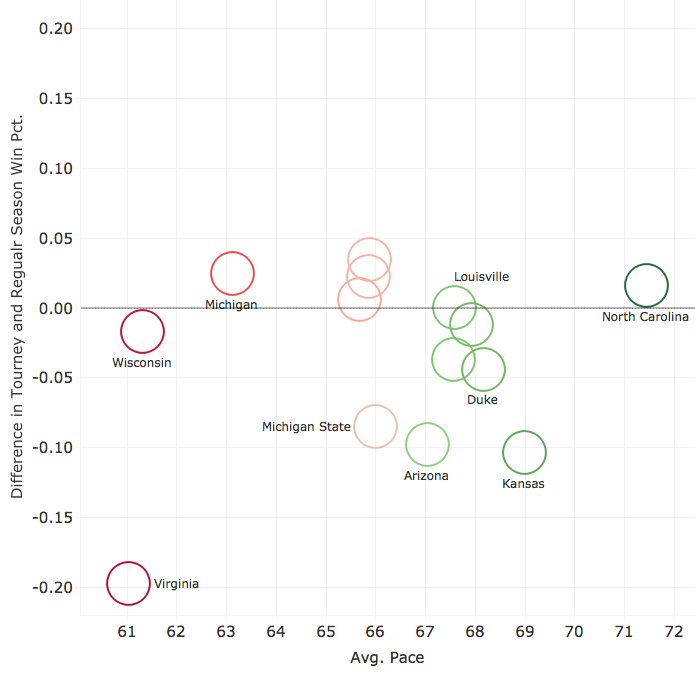
Do teams play differently in the Tournament?
Virginia has been abnormally bad in the postseason compared to other top programs, even those that play just as slowly. Is there truly something different about Virginia’s play that causes this? I would argue it is not in Virginia’s style but in a lack of games played. Virginia has played seven fewer Tournament games than the next lowest team, Arizona.
The winning percentage in the Tournament for slow teams is no different from the average rate, slow teams make the Final Four more often than faster teams, and top teams perform the same way in March as they do in the regular season. We should then expect that as Virginia plays more games in the Tournament, their March winning percentage will approach their regular season winning percentage.
The bias against Virginia is more emotional than basketball-related. When people watch the ‘Hoos, they do not see the style normally associated with elite programs. The four “blue bloods” — Kentucky, Kansas, Duke and North Carolina — are consistently the four fastest teams among top programs. That style is what is normally associated with the best college basketball teams. A fast pace is what college basketball fans and analysts are used to seeing win.
Not enjoying Virginia basketball is okay — well, no it’s not, it’s a thing of beauty — but saying the style makes them incapable of winning big games is lazy. Many analysts stop the argument there. They play slowly so they can’t win. Why? The style may be unfamiliar and unenjoyable to the casual fan, but it wins and it wins a lot.
While Virginia clearly has prior postseason failures, the entire body of work for the Cavaliers is impressive. Ultimately, the quality of the basketball will win out against the detractors of the style, and Tony Bennett will ultimately lead Virginia to the promised land. Whether this year is that year? We can only hope.

 Eye Test Sports